
Learn the accurate way to measure your waist for pants, understand pant sizing, and find the perfect fit for jeans, trousers, chinos, and casual pants without guesswork.
Introduction
Buying pants should be simple, yet many people end up with a pair that feels too tight, too loose, or simply uncomfortable. One of the biggest reasons is inaccurate waist measurements.
If you have ever wondered how to measure waist for pants, the good news is that you do not need professional tailoring skills or special equipment. With a measuring tape and a few minutes of your time, you can determine your correct waist size and improve the fit of your jeans, trousers, chinos, and casual pants.
In my experience working with clothing measurements and sizing guides, a properly measured waist can significantly reduce returns, sizing mistakes, and unnecessary frustration. This guide walks you through the process step by step and helps you understand how pant sizing actually works.
Table of Contents
- Why Accurate Waist Measurement Matters
- What You Need Before Measuring
- How to Measure Waist for Pants at Home
- Measuring an Existing Pair of Pants
- Understanding Pant Sizes and Waist Charts
- Common Waist Measurement Mistakes
- Best Practices for Getting the Perfect Fit
- FAQs
- Conclusion
Why Accurate Waist Measurement Matters
Your waist measurement serves as the foundation for choosing the correct pant size.
A difference of even one or two inches can affect:
- Comfort throughout the day
- Appearance and silhouette
- Belt dependency
- Ease of movement
- Overall confidence in your outfit
Many brands use different sizing standards, which makes knowing your actual measurement more reliable than relying solely on size labels.
For example, a size 32 from one brand may fit differently than a size 32 from another. Knowing your true waist measurement helps you shop with greater accuracy.
What You Need Before Measuring
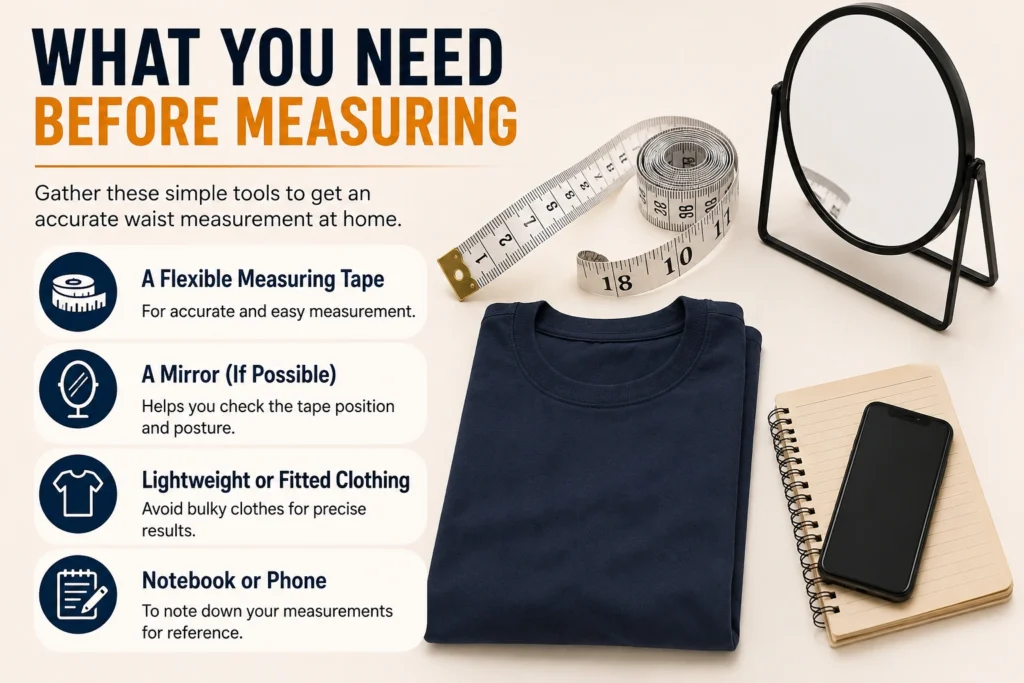
Before you start, gather the following:
- A flexible measuring tape
- A mirror if possible
- Lightweight clothing or fitted clothing
- A notebook or phone to record measurements
Avoid measuring over bulky garments because they can add extra inches and affect accuracy.
How to Measure Waist for Pants at Home
Step 1: Locate Your Natural Waist
Your natural waist is typically the narrowest part of your torso.
A simple way to find it is to stand upright and bend slightly to one side. The crease that forms is usually your natural waistline.
Step 2: Stand Naturally
Stand straight but relaxed.
Do not suck in your stomach or push it out. A natural posture provides the most realistic measurement.
Step 3: Wrap the Measuring Tape Around Your Waist
Place the measuring tape around your waist where you normally wear your pants.
Make sure the tape:
- Stays parallel to the floor
- Lies flat against the body
- Is snug but not tight
Step 4: Record the Measurement
Read the number where the tape meets.
For example, if the tape shows 34 inches, your waist measurement is 34 inches.
For better accuracy, repeat the process twice and compare the results.
Measuring an Existing Pair of Pants
If you already own pants that fit perfectly, you can use them as a reference.
Lay the Pants Flat
Button the pants completely and place them on a flat surface.
Measure Across the Waistband
Measure from one side of the waistband to the other.
For example:
- Flat waist measurement = 17 inches
- Waist size = 34 inches
Simply multiply the flat measurement by two.
This method is particularly useful when shopping online and comparing product size charts.
Understanding Pant Sizes and Waist Charts
A waist size chart for pants helps convert measurements into standard clothing sizes.
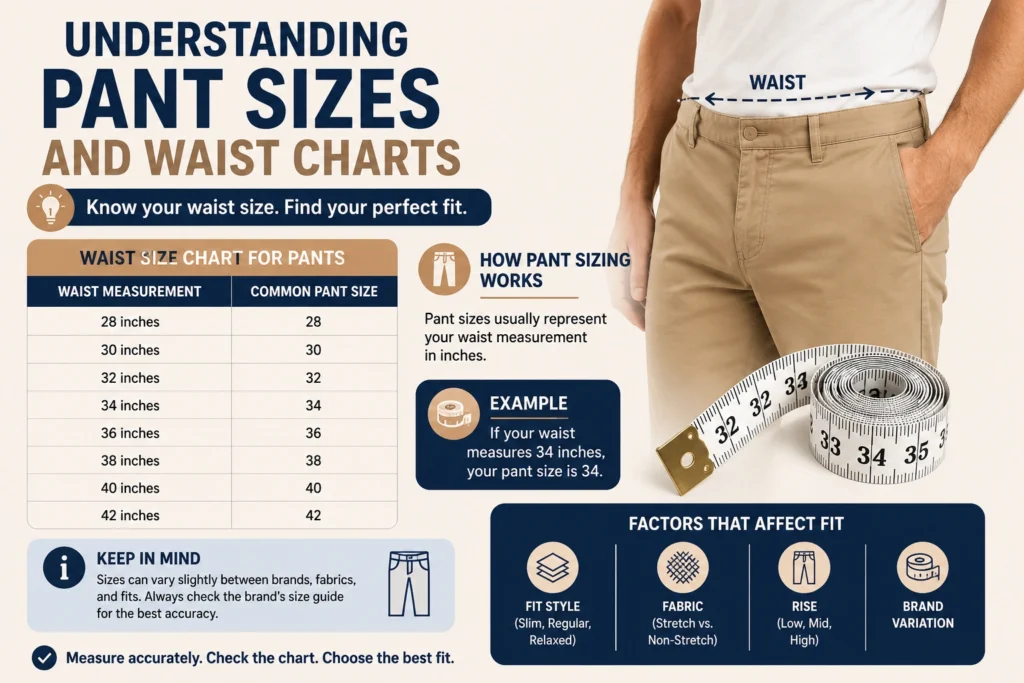
Example Waist Size Chart
| Waist Measurement | Common Pant Size |
|---|---|
| 28 inches | 28 |
| 30 inches | 30 |
| 32 inches | 32 |
| 34 inches | 34 |
| 36 inches | 36 |
| 38 inches | 38 |
Keep in mind that sizing can vary slightly between brands, fabrics, and fits.
For instance, slim fit chinos may feel tighter than relaxed fit trousers even if both carry the same waist size.
Common Waist Measurement Mistakes
Measuring Too Tight
Pulling the tape excessively tight often results in pants that feel restrictive.
Measuring Over Thick Clothing
Sweatshirts, jackets, and bulky layers can distort measurements.
Ignoring Rise Differences
Low rise, mid rise, and high rise pants sit at different points on the body. Always measure where you intend to wear the pants.
Relying Only on Old Sizes
Body measurements can change over time. Rechecking every few months is a smart habit.
Best Practices for Getting the Perfect Fit
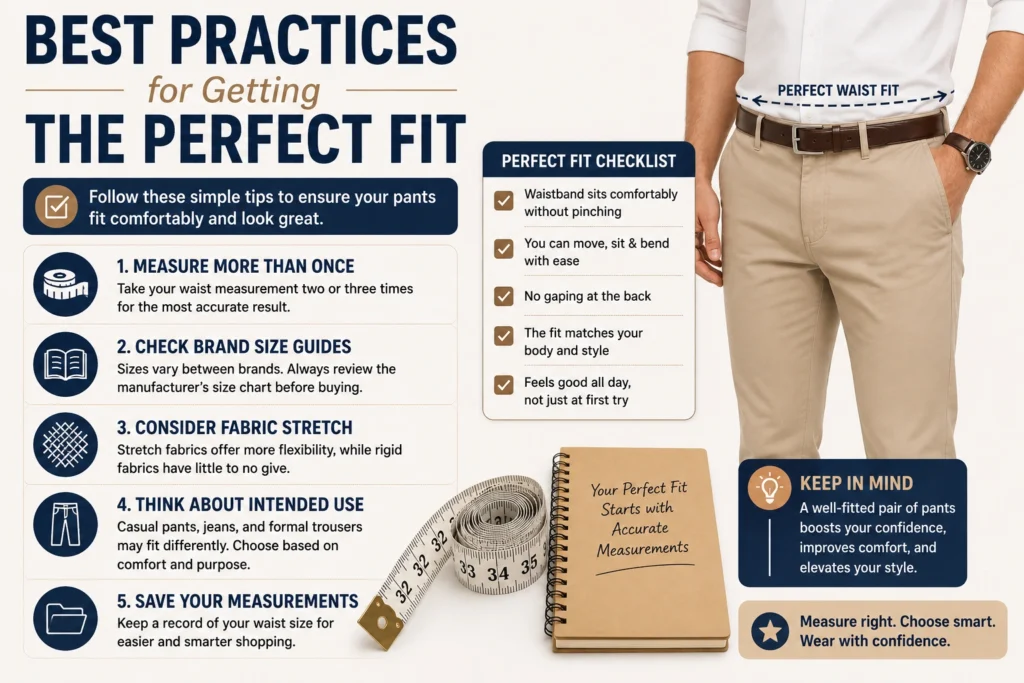
Measure More Than Once
Taking two or three measurements improves accuracy.
Check Brand Size Guides
Even when you know your waist measurement, reviewing the manufacturer’s chart remains important.
Consider Fabric Stretch
Pants with elastane or stretch blends may offer more flexibility than rigid fabrics.
Think About Intended Use
Work trousers, casual chinos, and denim jeans often fit differently.
For example, many people prefer a slightly roomier fit for everyday casual wear but a more tailored fit for office trousers.
Save Your Measurements
Keep your waist measurement stored on your phone. It makes online shopping faster and more accurate.
Frequently Asked Questions
How do I measure my waist for pants without a measuring tape?
You can use a string or cord, wrap it around your waist, mark the overlap point, and then measure the length with a ruler.
Should I measure my natural waist or where my pants sit?
Measure where you normally wear your pants. This provides the most practical sizing result.
Why do my pants size and waist measurement differ?
Many brands use vanity sizing or slightly different sizing standards, which can create differences between labeled size and actual measurements.
How often should I check my waist size?
Checking every few months is a good idea, especially if your weight or fitness routine changes.
Can I use old pants to find my waist size?
Yes. Measuring the waistband of well fitting pants is one of the easiest and most reliable methods.
Conclusion
Learning how to measure waist for pants is one of the simplest ways to improve your clothing fit and shop with confidence. Whether you are buying jeans, chinos, trousers, or casual pants, an accurate waist measurement helps eliminate guesswork and reduces sizing mistakes.
By following the steps in this guide, using a reliable waist size chart for pants, and double checking your measurements, you can find pants that feel comfortable and look great every time.
CTA
Looking for more practical clothing fit guides? Explore our latest fashion and sizing articles to make every purchase a better fit for your wardrobe.